
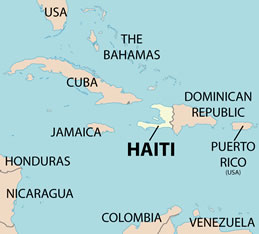
SSR in Haiti
Despite moderate successes last year to rid Haiti’s cities of armed gangs, the country is far from stable, and has been weakened further by a series of hurricanes that devastated the island nation over the last two months. Serious crime – especially kidnapping and drug trafficking – is still rampant, and has the potential to undermine political progress. Haiti’s newly confirmed prime minister, Michèle Pierre-Louis and President René Préval need to act immediately and decisively, with help from donors and the UN peacekeeping mission (MINUSTAH), to establish a professional police force and functioning justice and penitentiary system to move the country toward stability.
Creating a modestly sized 14,000-strong Haitian National Police (HNP) by 2011 is a pivotal element of Security Sector Reform (SSR). The vetting of the approximately 9,000 active duty HNP officers has been much too slow and insufficiently transparent to address concerns that individuals responsible for human rights violations and corruption remain in the force. Making decisive and swift headway with SSR is a vital part of any durable solution to Haiti’s problems. The process to create a 14,000-strong Haitian National Police (HNP) must be accelerated.
Moreover, strengthening the justice sector, including the dysfunctional penitentiary system, is key. Haiti still lacks the basic ability to detain, prosecute and sentence offenders, especially those responsible for serious crimes. To strengthen the rule of law, it is crucial that the new government speed implementation of the justice legislation passed in late 2007 and establish special chambers to bring cases of serious crime to trial. The justice system should be capable of upholding the rule of law, and the government should be able to offer swift, visible relief to families enduring extremely harsh living conditions.
Border control and economic development along the border with the Dominican Republic are vital to security and the economy as well. The new government should define a strategy that includes migration, economic and environmental issues, as well as confronting transborder organised crime and law enforcement, and reach out to recently re-elected Dominican President Leonel Fernández. Without improved cooperation, Haiti’s Border Development Commission and MINUSTAH’s expanded role along the frontier will be futile.
These challenges are all the more urgent, as they are compounded by the damage wrought by hurricanes Fay, Gustav, Hannah and Ike. Roads are still blocked, bridges are down, and the country’s agricultural heartland is flooded. More than 100,000 people are displaced and another 130,000 families face devastation to their farms and homes. Local businesses are crippled. Food distribution to rural communities is critical but is nearly impossible because of the continuing mudslides. In hard-to-reach areas, there is a real danger of famine. Quick disbursement of international emergency and recovery assistance is of crucial importance for the new government.
Haiti’s economic and political future depend on the government’s success in enhancing citizen security, assuring more effective and impartial law enforcement and bringing access to justice to the poor majority of the population across the country.
This was written by Mark Schneider, Senior Vice President and Special Adviser on Latin America for International Crisis Group.
Useful links for SSR in Haiti
- UN Stabilisation Mission in Haiti
- International Crisis Group
- UN Development Programme (French and Creole only)
- Organisation of American States (OAS)
- USAID
- CIDA
- PACT
- Pan-American Development Foundation
- National Center for State Courts
- Institute for Justice and Democracy
GFN-SSR Document Library
The Document Library contains links to a number of SSR related documents either focussing specifically on SSR in Haiti looking at the country alongside others as a case study. A selection of these are listed below:
- Security Sector Reform and UN Integrated Missions: Experience from Burundi, the Democratic Republic of Congo, Haiti, and Kosovo
How can the UN engage effectively in post-conflict Security Sector Reform? What lessons can be learned from multidimensional peacekeeping missions in Burundi, the Democratic Republic of Congo, Haiti and Kosovo? This book from the Geneva Centre for the Democratic Control of the Armed Forces (DCAF) examines the role and experience of UN integrated missions in post-conflict SSR. A common, comprehensive and coherent approach is necessary to enhance UN SSR support. This is especially important in the areas of strengthening local ownership and domestic oversight and accountability of the security sector. - Reforming Haiti’s Security Sector
The violent April 2008 protests against the high cost of living underscored the continued fragility of Haiti’s security situation and the need for rapid progress in security sector reform (SSR). This International Crisis Group report examines Haiti’s security sector and argues that stability lies in expediting and concluding reforms to the police and justice sector, and improving cross-border cooperation with it neighbours. These challenges are all the more urgent, as they come at a time when Haiti is struggling with severe hurricane devastation. - Latin America and the Caribbean: Domestic and Transnational Insecurity
How is Latin America and the Caribbean coping with the non-traditional security challenges it faces? This paper examines the two key axes of security dynamics: weak governance and citizen insecurity, and trans-national organised crime. It explores their interlinkages and evaluates coping mechanisms. It identifies the most likely future security scenarios in the region and suggests a number of ways in which regional insecurity might be addressed more effectively. However, the development of a common security agenda remains an elusive goal. - Haiti: Prison Reform and the Rule of Law
What risk does prison overcrowding, understaffing and insecurity pose for wider security and justice sector reform efforts in Haiti? This policy briefing from the International Crisis Group examines the problems facing the Haitian prison system. It argues that extreme prison overcrowding threatens Haiti’s security and stability. The most urgent need is to relieve existing prisons by using other space temporarily, while supporting the detention commission in accelerating treatment of pre-trial cases. These measures must be accompanied by construction to meet prison requirements for a generation. - Haiti: Justice Reform and the Security Crisis
What are the challenges facing justice reform in Haiti? What lessons have been learned from the failed interventions of the 1990s? This policy briefing from the International Crisis Group examines Haiti’s justice system, efforts at reform and the security crisis. It argues that Haitians and international donors need to review past failures and devise, fund and implement a comprehensive rule-of-law strategy. Building a sustainable criminal justice system will require both short-term actions to address the current crisis and longer-term institution-building. - The Post-Conflict Security Sector
How effectively has the international community dealt with (re)construction of the security sector in countries facing international engagement following severe conflict? This paper, for the Geneva Centre for the Democratic Control of Armed Forces (DCAF), evaluates (re)construction efforts in Afghanistan, Bosnia and Herzegovina, Haiti, Kosovo, Sierra Leone and Timor-Leste. It is argued that external actors have tended to take a limited approach to the security sector. They have focused on the efficiency of security institutions while neglecting managerial and governance capacity. - The call for tough arms controls: Voices from Haiti
What impact have irresponsible arms sales had on people’s lives in Haiti? How have groups that commit human rights violations been able to obtain weapons? This report from the Control Arms campaign examines the supply of arms to Haiti and its effect on individuals and communities. It argues that irresponsible arms transfers are fuelling atrocities in Haiti. Governments must take responsibility for the supply of arms, by agreeing a new international arms trade treaty. - Security and Post-Conflict Peacebuilding: The Role of the United Nations
Peacebuilding and security are not parallel concepts; security is essential to peacebuilding. This document, published by the United Nations (UN) Office at Geneva (UNOG) and the Geneva Centre for the Democratic Control of Armed Forces (DCAF), discusses the crucial role of security in post-conflict external interventions. While security in peacebuilding is paramount, it must be combined with humanitarian assistance, development and human rights protection. - Security Sector Reform in Haiti
Despite multilateral attempts in the 1990s to institute security sector reform (SSR) in Haiti, lack of elite support, insufficient judicial sector capacity and persistent corruption has led to the current resurgence of violence. This study, published by International Peacekeeping, examines recent international interventions to institute SSR in Haiti. National dialogue with local elites and long-term donor involvement are necessary to ensure that justice, security, development and governance sectors are developed simultaneously to prevent the country from becoming a failed state.